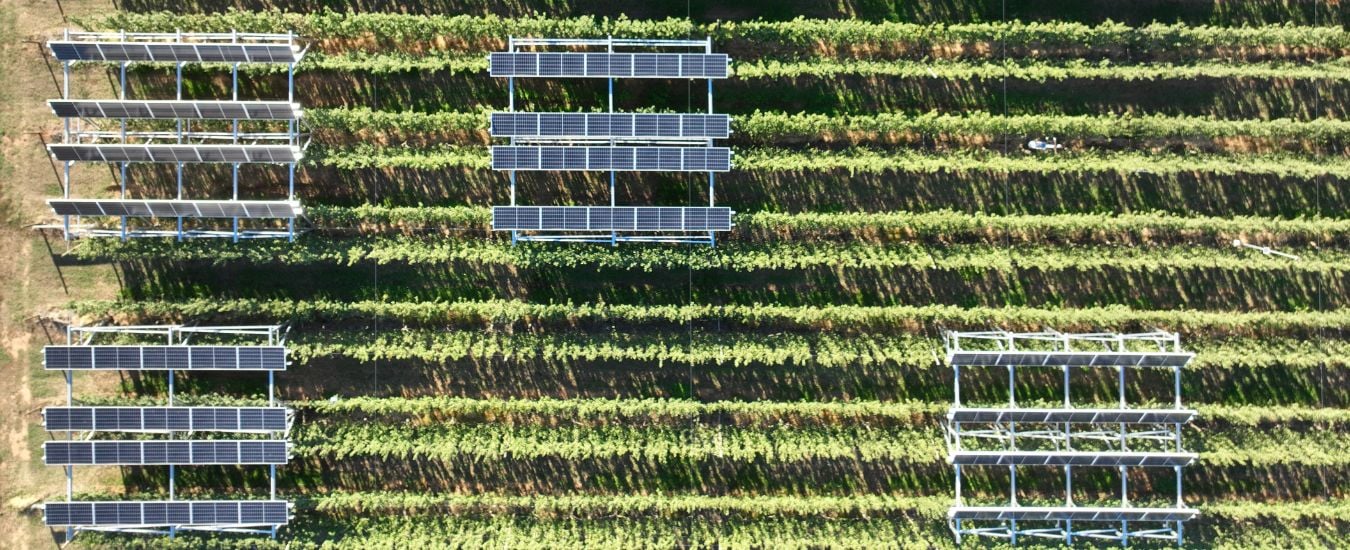
Doctors Ian Goodwin and Alessio Scalisi from Agriculture Victoria present findings from their leading four-year agrivoltaics experiment at the Tatura SmartFarm, Panels Over Pears. This research is among the first worldwide to deliver results on the long-term impacts of solar panels over fruit crops. The study investigates the effects of fixed solar panels on pear yield and fruit quality, providing valuable insights for international agrivoltaics development. Two panel configurations were tested: panels tilted 45° west, intercepting 40% of incoming sunlight, and panels tilted 5° west, intercepting 47%.
The panels significantly reduced fruit damage from environmental stressors. Hail damage in control trees was approximately 30–35%, compared to just 13% under the 5° panels. Similarly, sunburn damage, which averaged 5–7% under control conditions, fell to less than 1% with panel protection. However, these benefits came at the cost of yield and fruit quality. Yield reductions over four years were 35% for the 45° panels and 45% for the 5° panels, largely due to reduced crop loads and smaller fruit size. Shading also diminished the red blush essential for marketing blush pear varieties, although green-skinned varieties such as Packham would likely be less affected.
Doctors Goodwin and Scalisi noted that while fixed panels provide significant protection, emerging technologies — including movable panels and semi-transparent photovoltaic designs — could better balance crop protection with yield and quality requirements.
Agriculture Victoria continues to invest in agrivoltaics research, recognising its potential to inform the development of integrated crop and energy production systems under changing climatic conditions.
Transcript: TRANSCRIPT-Growing-horticulture-through-protected-cropping-innovation
Acknowledgements
The “Growing horticulture through protected cropping innovation” project (AS23001) is funded through Hort Innovation Frontiers with co-investment from Applied Horticultural Research (AHR), Flavorite Hydroponic Tomatoes, The Costa Group, Apex Greenhouses, The Victorian Department of Energy, Environment and Climate Action (DEECA), PolyBee and contributions from the Australian Government.
Further information links
- Long-term effects of agrivoltaics on yield and fruit quality performance of bi-color (blush) pears – ScienceDirect
- Effects of above-canopy photovoltaic arrays on crop yield and fruit quality in a pear orchard