

Managing the catch once it hits the deck is a major consideration for any skipper. Choosing/designing the right kind of hopper to improve catch handling for your boat can be a great step forward.
The “Fish-First Barrel Hopper” is an innovative system developed by Ella Mae Fishing Pty Ltd. to improve the handling of catches and the survival of bycatch in the prawn industry. The unique design exploits the vertical separation of fish and prawns that occurs naturally when held in a water-filled hopper.
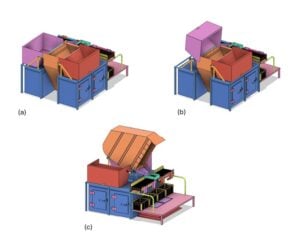
The fish first barrel hopper comprises two side bins (pink and red) and a main hopper (orange)- see (a) below. The side bins can be pivoted to release catch into the main hopper (b) which then gently pours water and the catch onto the sorting tray (c). The advantage of this system is that by gently pouring and sorting the more buoyant fish first, discard handling is quicker and less damaging. This improves fishing sustainability and leaves a cleaner prawn catch for regular grading. This system also reduces crew workload and fatigue, and also increases catch quality and with it, profits.
To find out more listen to Dave Sterling and Steve discuss this style of hopper (below):
What do you think about this idea?
Would you consider installing this on your vessel?
Let us know in the comments below or join the discussion on Wharf Talk


2 comments, add yours.
Chay Haldane
Hi David,
This Hopper looks very interesting, I too have been thinking of a way of removing the fish that swim higher in the hopper that the prawns. I was considering a similar tipping mechanism but that delt with the tables first and spilt fish straight over the side before going in to the central hopper. Does your design require the central hopper to be completely emptied before tipping the tables in? I would be interested to see more detail about how you might get around the problem of slosh with baffles that don’t then get blocked up with product.
Cheers,
Chay Haldane
David Stirling
Hi Chay,
Thanks for your interest and for sharing your ideas — it’s great to hear different approaches to the same challenges.
In the FFBH concept, what you call “tables” I refer to as overflow trays. The normal sequence is:
Overflow tipping — When the codends are emptied, all catch goes into the central hopper unless we need to keep codends separate or the hopper is overloaded. Any catch landing in the overflow trays is tipped into the hopper first.
Water push — The hopper starts about ¾ full of water. As catch and overflow contributions are added, excess water escapes through a perforated section at the top. Once filled, that section is blocked so water rises, pushing product down the spillway at a controlled rate.
Rotation — The hopper is rotated at a controlled speed to match sorting, until emptied.
The process is flexible. For example, you can half-empty the hopper (remove fish), then return it to load residual overflow tray catch and continue the sequence. This lets fish and prawns be managed in a desirable order without major hold-ups.
On the slosh issue: we’re using curved baffles to reduce free-surface effects, with passages that allow product to move slowly toward the spillway. The passages are positioned so they only allow flow at certain rotation angles and are staggered between baffles. This ensures the hopper cross-section never becomes a full free surface. To further dampen water/catch dynamics, the output is regulated by a “surge arrester” flap. The aim is to minimise surging without damaging product or creating blockages.
I can send through drawings of the MVP baffle implementation, and I’d be keen to compare notes on how your “table-first” idea might link into the hopper concept. Your approach sounds like it could add useful synergies.
Cheers,
David