
What began as a voluntary, industry led pilot study to test the effectiveness of LED lights in reducing bycatch is now turning heads with the “unique” method having major impact.
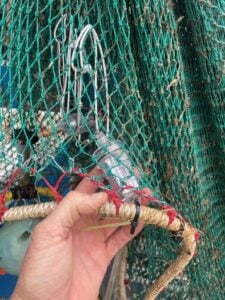
LED lights are showing promise in reducing bycatch for South Australian prawn fishers
A bright idea from the Spencer Gulf and West Coast Prawn Association (SGWCPA) is turning heads among fishers and researchers with some positive preliminary findings.
What began as a pilot study to test the effectiveness of LED lights as part of SGWCPA’s ‘Innovation Month’ in 2021 has led to more robust research trials as part of FRDC project 2023-039 in the Spencer Gulf Prawn Fishery.
South Australian Research and Development Institute (SARDI) Senior Research Scientist Dr Kat Heldt, who is the project lead, says while lights may not work for all fisheries, it’s a “pretty unique” method for reducing bycatch and has been effective for SA’s prawn fisheries.
“We’re focusing on 20 key species which includes Bluefin Leatherjacket (Thamnaconus degeni), Rough Leatherjacket (Scobinichthys granulatus), Toothbrush Leatherjacket (Acanthaluteres vittiger), Red Mullet (Mullidae) and Skipjack Trevally (Pseudocaranx wrighti). We’ve seen a significant reduction in bycatch,” Kat says.
Green light a go
Initially, industry trialled green and blue lights – colours used in other net fisheries – however green light was the most effective for reducing bycatch in this study.
“Based on literature around how light works with water depths and the depths that they’re fishing, green is a pretty happy medium,” Kat says.
The next steps for the FRDC trial was to compare how four lights worked against two.
“We did that by testing whether or not we would still have bycatch reduction with two lights and how that would impact the prawn catch,” she says.
“We found there was less impact on prawn catch with two lights and we still had a reduction in bycatch.”

SARDI Research Officer (RO) Graham Hooper and SARDI Research Services Officer (RSO) Chris Presser, both of whom worked significantly on the project, measuring prawns.
Easy application
Another benefit is the practicality for fishers to use lights on their vessels.
“They’re simple to use; they’re simple to test,” she says.
“We’re literally just clipping them on and then you’re done. If a fisher comes to an area that they know they can get clean catches or where they may not work and they don’t want to risk any impact on their prawn catch, then they can just unclip them or turn them off potentially, depending on what brand they get.”
The ultimate goal with the use of these lights on the headline of a trawling system, is to give the fish a visual cue to see what’s ahead, which will hopefully allow the fish time to respond and move away from the net.
“We did trials where we had the lights on the top and bottom (of the trawl net) and we found there wasn’t much of a benefit to have that additional light on the bottom (the footline),” she says.
Kat adds having the lights on the headline also means there’s less likelihood for light gear to be damaged.
Finding the right light match
Another key factor when analysing the effectiveness of lights in reducing bycatch is vessel speed.
“Speed plays a key role because what you’re doing is you’re highlighting the headline of the trawl and we know the vision and swimming speed of fish is variable across species, so it’s pretty important to understand what species we’re looking at,” Kat says.
As more fisheries become interested in lights, Kat says she’s excited to see how the lights work in tandem with other bycatch reduction devices (BRDs) such as escape panels, fisheyes and Nordmøre-grids.
“If you’re not getting the efficiencies or the reductions you wanted with your fisheye, you could try putting lights within your net and see whether that helps.”
Kat says what it all boils down to is “finding the right match”.
“There are reasons for some BRDs not being taken up in particular fisheries and in some cases with lights some fish might actually be attracted to the lights. The challenge here, since lights are so new, is understanding that while it may work effectively for one area in one fishery, it might not be the same for another.”

SARDI Research Scientist Dr Kat Heldt is the project lead for FRDC project 2023-039.
More information
SARDI Senior Research Scientist Dr Kat Heldt
FRDC project 2023-039 ‘Assessing the effectiveness of LEDs, T90 cod-end/grid trawl systems and net modifications for reducing bycatch and improving efficiency and selectivity of catches in South Australian prawn fisheries’