
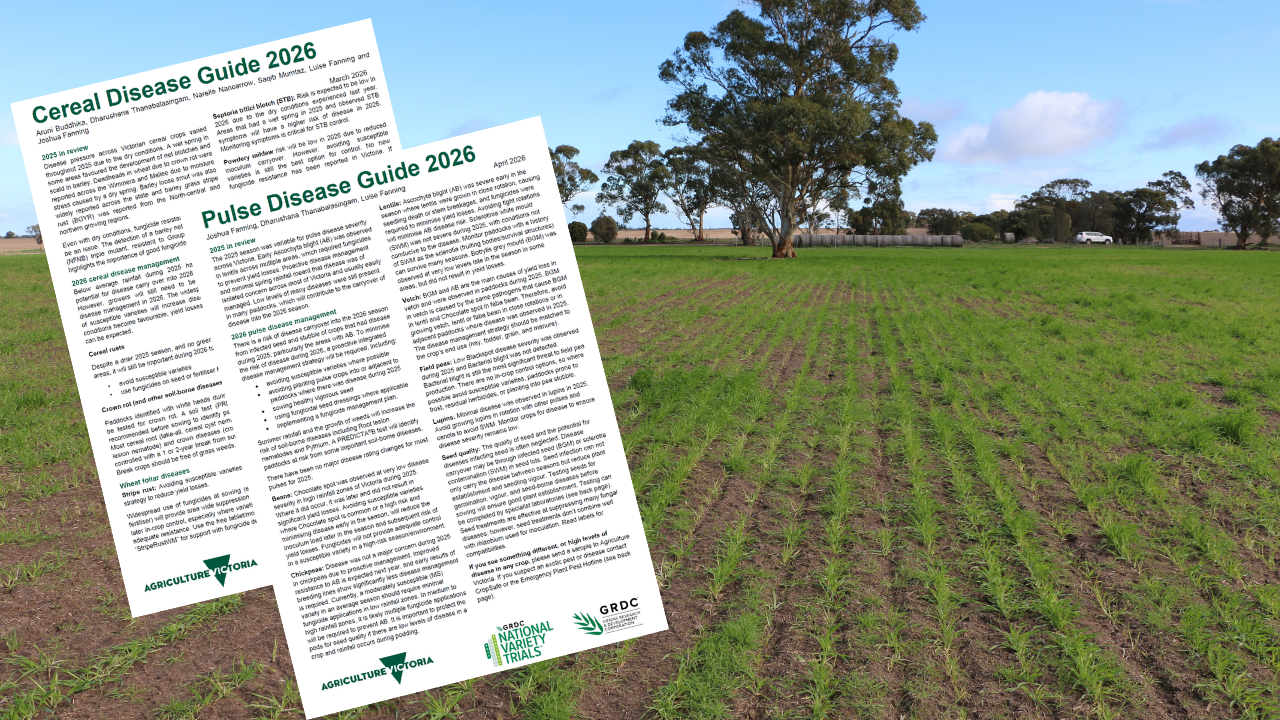
The 2026 disease guides for Victoria provide Victorian growers and advisers with current information on field crop diseases in cereals and pulses, including disease management advice, resistance ratings and fungicide resistance considerations for the coming season.
Due to the below average rainfall during 2025, there is a reduced potential for disease to carry over into the next season in many areas. However, growers should be proactive with disease management in 2026. The widespread cultivation of susceptible varieties will increase disease risk. If conditions become favorable, yield losses are expected due to disease.
What’s new in 2026
Cereal disease guide updates for 2026
New varieties have been added to the wheat and barley tables.
Pulse disease guide updates for 2026
There have been no major changes to the disease rating of most pulses for 2026.
New varieties have been added to the lentil, field pea, lupin and vetch tables.
Disease management recommendations for Victorian crops
To minimise disease risk, particularly in areas with foliar disease during 2025, a proactive integrated disease management strategy is required. With disease ratings delayed this year, our guide was also delayed until sowing was commenced, so recommendations are for in season options.
Increase monitoring for diseases and a proactive management plan will be required where
- Susceptible varieties were sown,
- Crops are planted on the same crop stubble or adjacent to the same stubble as the 2026 crop,
- Seed or fertilizer treatments were not applied (if applicable),
- Seed sown during 2026 was off a crop that had disease, particularly pod symptoms,
- Conducive conditions eventuate
- Good soil moisture
- Bulky crops
- Consistent rain, fog, dew
- Where susceptible varieties are sown, plan on a proactive management strategy for in-season control.
Summer rainfall and the growth of weeds will increase the risk of soil-borne diseases. A soil test (PREDICTA B®) is recommended before sowing to identify paddocks at risk. It can also be used in season to determine risk or validate visual symptoms.
Fungicide resistance
There are five strategies that can be adopted to slow the development of resistance in pathogen populations and extend the longevity of the limited range of fungicides available:
- Select less susceptible varieties,
- Rotate crops,
- Use non-chemical methods,
- Spray only if necessary and apply strategically,
- Rotate and mix fungicide modes of action.
Further disease guide resources for Victoria
For more information visit 2026 Cereal Disease Guide or 2026 Pulse Disease Guide
Download a current copy of the pulse disease guide here
Download a current copy of the cereal disease guide here
Fungicide resistance, visit www.afren.com.au
Identification & Management of Field Crop Diseases in Victoria
To download a range of disease management apps, visit Diagnosing disease in Victoria: there’s an app for that
Thank you to Joshua Fanning (Agriculture Victoria) and Luise Fanning (Agriculture Victoria) for reviewing the article. The author wishes to acknowledge the funding provided by Agriculture Victoria and the GRDC that allows this work to occur.