An early estimation of crop density is an important agronomy tool to manage canopy density for the season and make input decisions depending on the spring outlook. Early stages of crop development can have a major influence on final crop yield.
Estimation method
- Choose the paddock and list the paddock name for your reference.
- Walk the paddock in your preferred sampling method and select areas that are representative of the cropping area.
- Use a 50cm ruler, stick or ideally a tape measure to conduct counts over the paddock and other parts of the farm. Place it at random between 2 rows of crop.
- Count and record the number of plants on both sides of the 50cm ruler (equal to the plants in a metre of row). Enter this number into the plant counts (per metre) box in the calculator. Repeat the measurements in 10 different locations entering the count into the calculator.
- Counts can be done more than ten times to test consistency and if there is high variability. If the paddock is zoned with different soil classes which has influenced crop emergence and produced large variability, these parts of the paddock should be counted and treated separately. The average will be determined from the calculator.
- Enter the seeder row spacing in centimetres to convert from plants per metre of row to plant per square metre (or plants per ha for summer row crops)
- In the comments section, list the crop type, position of the paddock for a reference of where the plant counts have been calculated and any other details that have influenced plant density, e.g. stubble cover, pests/diseases, soil type, insect or chemical damage.
You can send the record to yourself or your agronomist by email. Alternatively, take a screen shot of the phone. Plant numbers can then be compared to optimum plant density guides according to rainfall zones.
Smart phone example
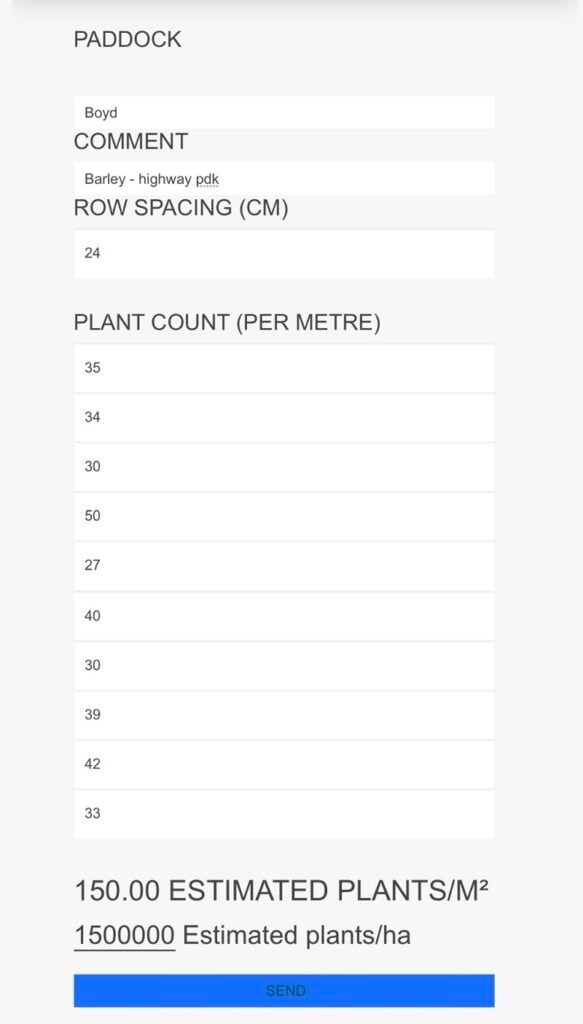
Email report to yourself or your agronomist

Accuracy of plant density calculation estimates depends upon an adequate number of counts being taken so as to get a representative average of the paddock. The plant estimate determined will only be a guide and assumptions made from the estimates contain a degree of uncertainty.
Refer to the Agriculture Victoria website for information on growing grains, pulses and cereals.

Disclaimer
The content of this Victorian Government website is provided for information purposes only. No claim is made as to the accuracy or currency of the content on this site at any time.
The Victorian Government and this agency (Department of Energy, Environment and Climate Action) do not accept any liability to any person for the information or advice (or the use of such information or advice) which is provided on this website or incorporated into it by reference. No responsibility is taken for any information or services that may appear on any linked websites.