
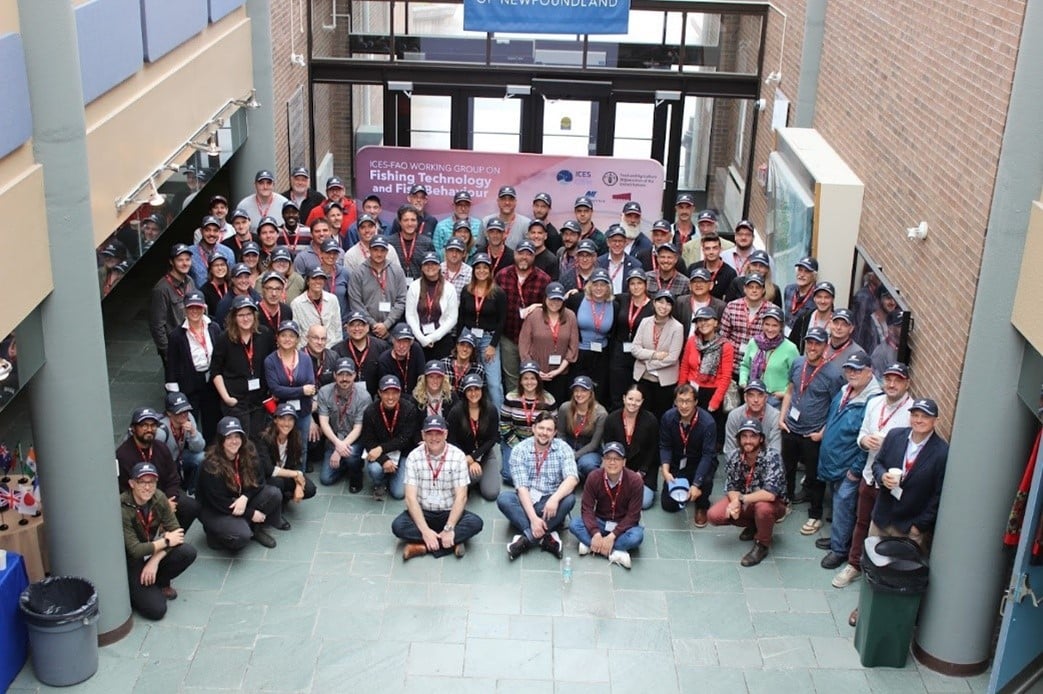
In 2025 the WGFTFB (more formally known as the ICES-FAO Fishing Technology and Fish Behaviour Working Group) met over 6 days in Sicily, Italy, to present research findings and discuss developments in fishing technology under the theme “Innovative Horizons in Fishing Technology”.
The WGFTFB meets annually, and presentations usually focus on the design, development, and testing of commercial fishing gears, including selective fishing gears to reduce bycatch, discards, and unaccounted mortality, seabed impacts, fuel consumption, and carbon emissions.
This group has traditionally been comprised of fishing technologists and other gear researchers from 20 ICES member countries spanning North America and Europe. More recently it has included individuals from Australia, New Zealand, S. E. Asia, and South America.
The following is a list of topics and presentations from the meeting, certainly plenty of food-for-thought for shaping up Australia’s Innovative Horizons in Fishing Technology!
For more info on each check out the Abstract List or feel free to get in touch through Wharf Talk (Channel 16).
Session Topics and Presentations (WGFTFB2025)
- Catch Welfare
- Atlantic Bluefin Tuna: Study on stress during rod-and-line capture.
- Codend Dynamics: Impact on catch welfare in trawl fisheries.
- Animal Behaviour
- Antarctic Krill: Herding behaviour inside trawls.
- Shrimp Fisheries: Use of light to attract brown shrimp.
- Sorting Grids: Fish behaviour in relation to sorting grids.
- Indicators
- Bottom Trawl Gear: Framework for assessing gear configuration impact on catch size and community metrics.
- Sorting Grids: Selectivity performances in Mediterranean bottom trawl fisheries.
- ALDFG/Gear Marking/Plastic Pollution/Gear Recycling
- Norway: Multi-stakeholder perspective on sustainable and circular management of fishing gears.
- FAO Survey: Global survey on abandoned, lost, or discarded fishing gear (ALDFG).
- Marine Plastic Debris: Impact on trawl fishery and codend selectivity.
- Multi-Use
- Offshore Wind Energy: Coexistence with fisheries practices.
- Participatory Mapping: Small fishing vessel activities for marine spatial planning.
- Gear Design – Fish/Invertebrate Selectivity
- Swedish Nephrops Fishery: Development of a size-selective grid.
- Demersal Seine Fisheries: Size selection at different depths.
- Gear Design – Mammal Selectivity
- Seal Mitigation: Technology to reduce seal interactions in New Zealand fisheries.
- MiniSeine: Small nets to reduce seal interactions and bycatch.
- Gear Design – Catchability
- Beam Trawl Design: Optimizing for sustainable sea star fishery.
- Fish Pot Design: Effects of entrance design on catch rates.
- Gear Design – Energy Efficiency
- Off-Bottom Trawling: Methods to improve energy efficiency in mixed-demersal fishery.
- Nephrops Trawl: Enlarged top sheets to reduce drag and improve fuel efficiency.
- Innovative Tools
- Bycatch Rates: Using glmmTMB to estimate mitigation effects.
- Zooplankton Trawls: Size selectivity and hydrodynamic performance.
- Human Dimensions
- Emerging Fisheries: Decision tree for managing new fisheries.
- Discard Policies: Incentives for selective fishing in England.
Numerous posters were also presented, with a focus on:
- Animal Behaviour
- Indicators
- ALDFG/ Gear Marking/ Plastic Pollution/ Gear Recycling
- Gear Design – Fish/ Invertebrate Selectivity
- Gear Design – Mammal Selectivity
- Gear Design – Catchability
- Gear Design – Energy Efficiency
- Innovative Tools
- Human Dimensions