
Fishers across Australia are seeing firsthand how the health of our catches depends on the health of our coastal and estuarine habitats. While the science is complex, the link is simple to fishers and the community: seagrass meadows, mangroves and saltmarshes aren’t just blue-carbon sinks, they are the nurseries that sustain prawns, crabs, and finfish.
“While the science (of Nature-Based Solutions) is complex, the link is simple to fishers and the community
~ Simon Rowe (OceanWatch Australia).
What’s a Nature-Based Solution?
Essentially, it’s a rebranding of something that we’ve been working on for many years, to turn these cryptic science challenges into opportunities. A nature-based solution is an action that works with and enhances natural ecosystems—like restoring wetlands, planting mangroves, or creating living shorelines—to tackle environmental and social challenges such as climate change, biodiversity loss, and community resilience. For example, we recently completed a project with the NSW Oyster Industry addressing the question of what to do with end-of-life oyster infrastructure and waste and part of the solution was employing a contractor from the Port Lincoln SA with a mobile shredding unit, setting up a recycling model. We’re now working on wider acceptance of cultural fire as a technique to reduce fuel loads behind mangroves as we saw these habitats cook during the 2019/20 bushfires for the first recorded time in history.

The SA crew during work shredding used plastics for a Jervis Bay Mussel farm.
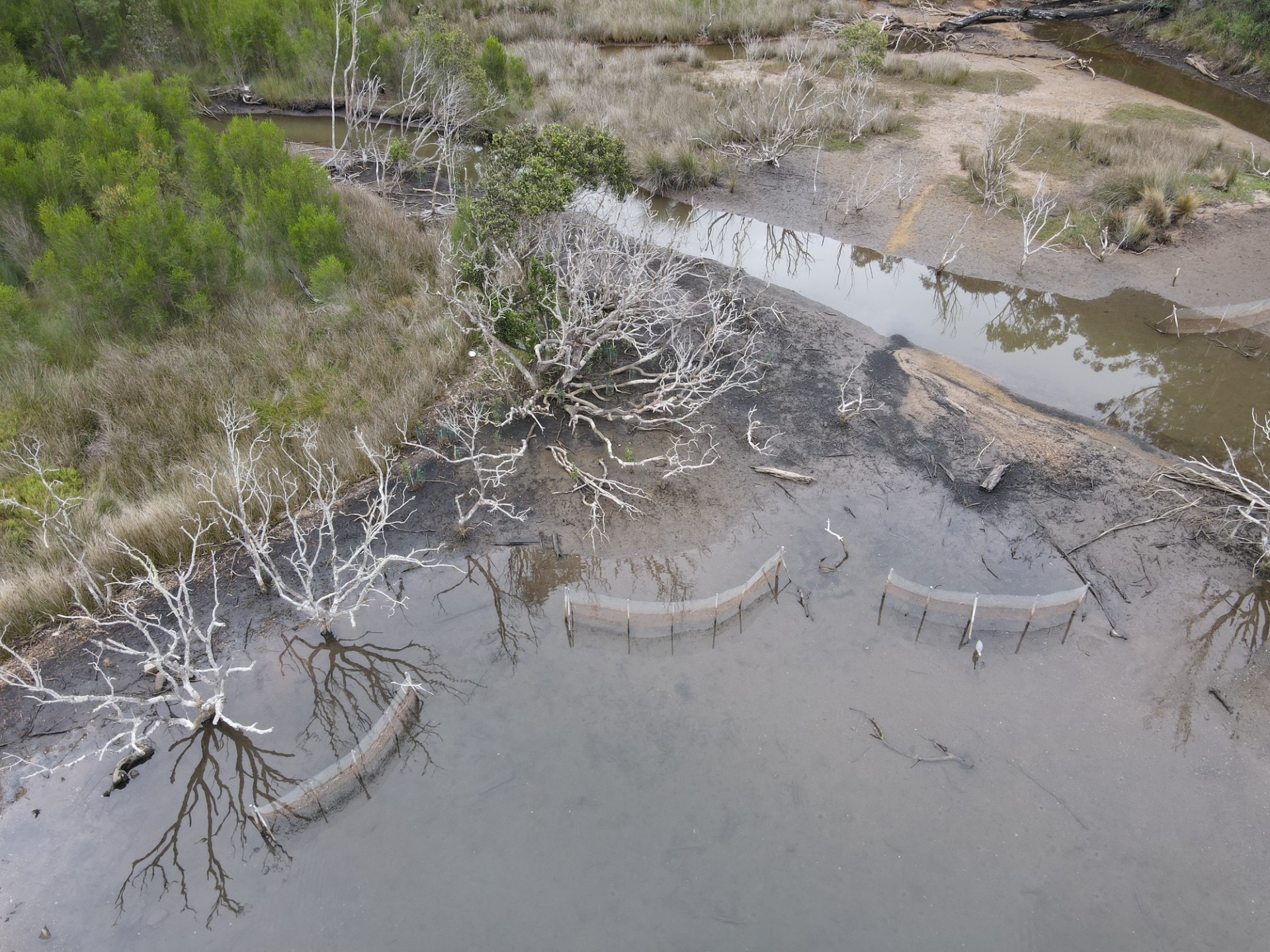
 Planting and temporary placement of wave and tree protection on mangroves post 2019 bushfire damage, Wonboyn inlet.
Why this matters now
Events like South Australia’s recent Harmful Algal Bloom, demonstrate how delicate the balance is and how vulnerable our marine systems are. While emergency responses are essential, they also provide an opportunity to invest in long-term resilience. Linking recovery funding to habitat restoration creates benefits that go well beyond short-term fixes — storing carbon, filtering nutrients, stabilising shorelines, and strengthening fisheries. Currently the figure is 97% of disaster funding is spent on recovery, mitigation and preparation for future events only receive 3%.
What works
From our previous experience, a few ingredients stand out:
- Partnerships matter – councils, Landcare groups, schools and local communities all bring extra hands, knowledge, and credibility.
- Connect to government priorities – whether it’s climate adaptation, circular economy, or blue carbon, aligning with existing agendas helps attract support.
- Tell the full story – these projects deliver triple benefits: healthier fisheries, stronger more caring communities, and restored ecosystems.
Looking ahead
When the global outlook is a challenge, local action and industry-led stewardship is empowering offer hope and a sense of community. There are a few other examples in various formats but a lot more could be done. We would like to see broader brush support for projects instigated that have dedicated officers to drive change at least in each state. We have models that have worked previously.
- FishAid – A dedicated officer that speaks with land managers around fisheries habitat concerns and seeks action to enforce existing policy.
- Tide to table – A devolved grants program that funds others to work on catchment health projects related to seafood sector needs.
- Tide to tip – Empowering aquaculture farmers to lead community cleanups of marine debris earning social license in the process.
- Living shorelines – Use of oyster shell to reduce wave energy and buffer shoreline erosion.
Research and Deployment.
If more fisheries step into this space, we’ll not only restore critical environments but also show governments and the community that industry is a proactive partner in nature repair. That makes it easier to secure funding and to scale up the kinds of projects that will keep our fisheries productive in the face of climate change.
Some interesting background reading:
- In Australia, approximately 97% of disaster-related funding is spent on recovery, only 3% on preparedness & mitigation
- Nature-based solutions (NBS) for climate resilience are 50% cheaper than grey alternatives and can deliver 28% greater added value in terms of productivity and positive externalities.
- Investing in nature-based solutions (NbS) could create up to 32 million new jobs globally by 2030.
- NbS could provide around 30% of the cost-effective mitigation needed by 2030 to stabilise warming to below 2°C, address biodiversity loss whilst also protecting life and property.
Simon Rowe (Operations Manager)
OceanWatch Australia.


M: 0434 351 977
National Marine NRM, recognised by the Australian Government
“alone a drop…together an ocean”
For more articles on Social Responsibility follow the link.


One comment, add yours.
Chay Haldane
Hi Simon,
I posted some comments about this topic last week on the platform (can’t remember which section) before I read this article. Nature based solutions is a good name for what I was talking about. I work in the Spencer Gulf Prawn Fishery and our Association has set up a Gulf Care Program that aims to highlight the importance of the juvenile prawn habitat and encourage the protection and restoration of these areas. It is good to see that other fisheries are doing similar projects.
I think there may be an opportunity to encourage long term Nature Based Solutions here in South Australia as part of the response to our current harmful algae bloom particularly with regard to mitigation of high nutrient loads associated with runoff. Any ideas on how we might push this thinking along? I was involved in a project quite a while ago now that sums up what we are trying to achieve in our fishery, you can check it out on Youtube ‘Secrets of the Saltmarsh Eyre Peninsula’ (5min Video).
Perhaps Nathan can some how put my comments form last week to link with this section.
Cheers,
Chay Haldane