
Ovens Murray
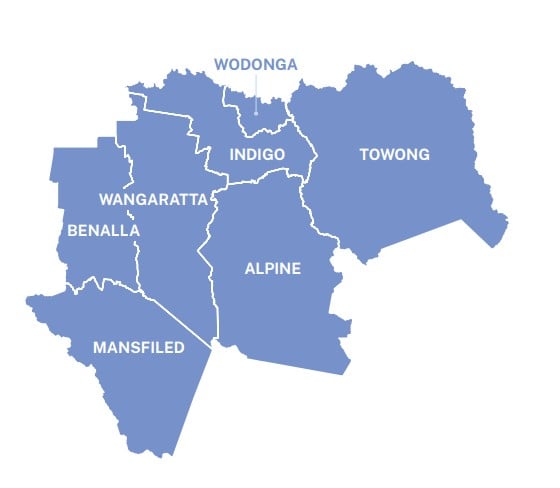
The recognised Traditional Owners of the Ovens Murray region include the Taungurung, Yorta Yorta, and Gunaikurnai Peoples, as well as other First Nations groups not formally recognised.
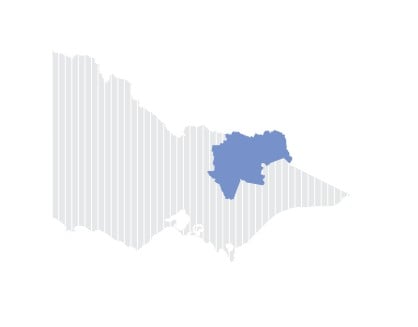
The Ovens Murray region is in northeast Victoria and forms part of the Murray-Darling Basin. Water flows from the alpine region down through the Ovens, Kiewa and Mitta-Mitta rivers. These catchments are nationally important, supplying 40% of the inflows into the Murray-Darling system. Due to its large national and state parks, less native vegetation has been cleared in the region than in other parts of the state.
Agriculture, forestry and fishing is the region’s second largest sector by employment, with beef, dairy, sheep and wool being the largest sources of agricultural production. Major food processors are based in 4 regional towns focused on grains and cereals, and beer, wine and dairy products.
The Ovens Murray Drought Resilience Plan was produced collaboratively by a wide range of local residents, groups and organisations. A Drought Resilience Reference Group was established to steer the Plan’s development and included key stakeholders with expertise in agriculture, regional development, water, governance, community and natural resource management.
Implementing activities in the Ovens Murray
North East Catchment Management Authority (CMA) is the Phase One Plan Coordinator for the Ovens Murray region receiving a $380,000 Implementation Grant to coordinate and deliver resilience building activities across the region.
North Central CMA are delivering 6 activities due for completion in the second quarter of 2026.
Activities underway include:
- Beyond the dry – a know-how and network building initiative for women in agriculture – empowering women in agriculture to respond proactively to drought, commencing with a support needs survey followed by a Women’s Gathering event and a series of targeted workshops, mentoring sessions, and webinars. Facilitated by a professional consultant, the activity aims to build leadership, technical skills, and social connections.
- Drought-ready Mansfield: Connecting land and community – equipping small and large landholders in Mansfield Shire with practical skills for managing livestock, water, and property during drought. The program also includes quarterly Women in Agriculture discussion sessions, to support women in the industry by building community connections and addressing specific needs and challenges that women experience during drought.
- Co-designing a psychological preparedness program for drought in the Ovens Murray region – strengthening psychological preparedness by co-designing a mental health toolbox with the Ovens Murray community, equipping individuals with coping strategies to manage stress and uncertainty, which are heightened during drought.
- Drought Preparedness Community Leadership Program – building drought preparedness and climate resilience through an applied leadership development program. Participants are engaging in real world problem-solving and experiential learning through structured program days in different regional communities and a regional study tour, gaining exposure to on-farm innovation, drought adaptation approaches and social capital building.
- Where are they now? Revisiting tree decline in North East Victoria – assessing the threats to paddock trees, and their sensitivity to drought, by examining changes in the extent and health of tree cover in north east Victoria – at a farm-scale and a regional landscape-scale. The activity will then identify strategies to increase the resilience of paddock trees to drought and other threats, such as compaction, high nutrient loads, insect attack, changing species distribution and storm damage.
- Soil moisture probe proposal – Upper Murray, Kiewa Valley and Ovens-King Valley – installing soil probes and weather stations across 3 sub-regions of north east Victoria (Upper Murray, Kiewa Valley and Ovens-King Valley) to provide real-time data on soil moisture and climate conditions, helping livestock farmers make informed, efficient, decisions in a warming climate. Data from these sites will be publicly available and 3 field days will be held to educate the wider community on the benefits of this technology.