
Honey from Australia’s native stingless bees is showing remarkable promise as a potent, stable, and natural antimicrobial. Our recent study found that honeys produced by Tetragonula carbonaria, Tetragonula hockingsi, and Austroplebeia australis have unique properties that could position them as valuable additions to the medicinal honey market.
Two layers of antimicrobial defence
Most honey’s antimicrobial activity comes from hydrogen peroxide (H₂O₂), produced by enzymes naturally present in the honey. This holds true for stingless bee honey – T. carbonaria samples in particular generated exceptionally high and sustained levels of H₂O₂, lasting more than six days.
But these honeys go a step further. Even after heat treatment, which breaks down H₂O₂ and inactivates enzymes, T. carbonaria and T. hockingsi honeys continued to inhibit microbial growth. This “non-peroxide activity” is rare outside of manuka honey and is especially valuable in medical settings, where stability under heat and while in storage is essential.
This dual action – peroxide plus non-peroxide – gives stingless bee honeys a broader and more resilient antimicrobial profile. Remarkably, T. carbonaria honey stored for 18 years still retained non-peroxide activity, pointing to the presence of highly stable bioactive compounds.
What’s behind the activity?
Chemical analysis revealed that stingless bee honeys are rich in antioxidants and phenolics – compounds linked to both antimicrobial and anti-inflammatory effects. Unlike manuka honey, where non-peroxide activity comes from nectar-derived methylglyoxal, the activity in stingless bee honey appears to be driven by bee-derived proteins, flavonoids, and possibly compounds leached from propolis storage pots.
These properties suggest a complex interplay between bee biology, foraging habits, and hive architecture – offering a rich avenue for future research.
A sweet future for native bee honey
While stingless bee honey yields are modest – typically under 1 L per hive per year – interest in native bees is growing across Australia. More beekeepers are managing hives for both pollination and honey, and recent regulatory changes now allow stingless bee honey to be legally sold as food.
With its strong, heat-stable antimicrobial properties and long-term shelf life, stingless bee honey holds promise not just as a functional food but as a natural therapeutic. To realise its potential, further work is needed on scaling production, refining storage techniques, and standardising quality.
Acknowledgements
- NSW Bushfire Industry Recovery Project Website: https://www.nsw-bushfire-recovery.com/home
- Fernandes KE, Levina A, Cokcetin NN, Haley D, Li J, Brooks P, Gloag R and Carter DA. (2025). Strong antimicrobial activity and unique physicochemical characteristics in honey from Australian stingless bees Tetragonula carbonaria, Tetragonula hockingsi, and Austroplebeia australis. Applied and Environmental Microbiology, 91(6): e02523-24. doi: https://doi.org/10.1128/aem.02523-24
- This article was peer-reviewed by Michael Holmes and Nadine Chapman.
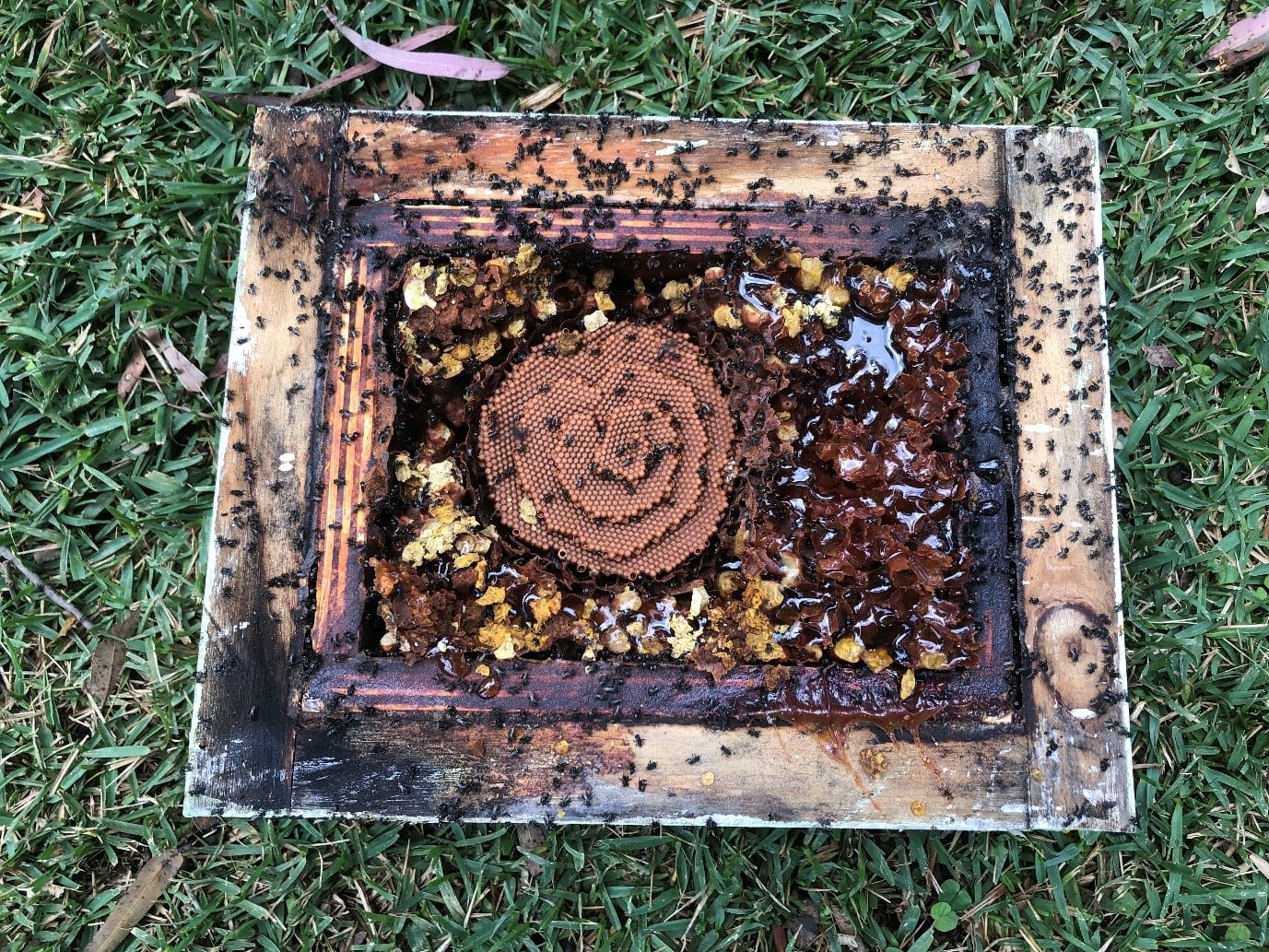
- Main image: Inside a Tetragonula carbonaria colony showing honey and pollen pots and the spiral brood comb.