
Please read ‘An introduction to analysis of enablers and constraints to adoption’ before proceeding with this post.
Stage 2: Adoption analysis and target setting for innovation/practice
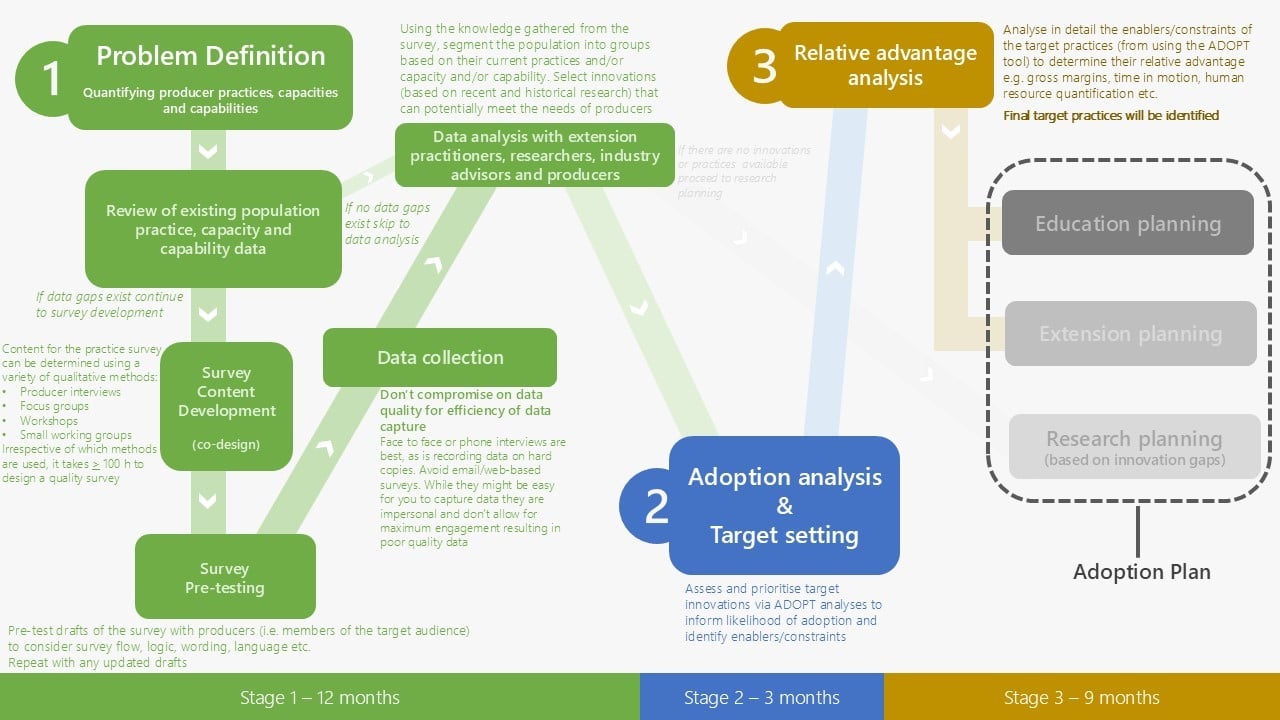
Stage 2 of adoption planning revolves around use of the ADOPT Tool and the collection of high-quality data to ensure the outputs it provides are as accurate and useful as possible. Producing a usable output from the ADOPT Tools is an iterative process and is likely to take 2 – 4 cycles. It typically takes 1 ½ hours to run a single analysis on a particular innovation/new practice.Assessment and prioritisation of target innovations/practices using the ADOPT tool is a co-design/collaborative process. When populating the ADOPT Tool it is highly recommended you assemble a team of people (3 – 5) that have familiarity with both the innovation and/or the target population. A cross-functional team in combination with objective data will ensure the process has unique points of view and wide-ranging insights, all of which contribute to high-quality outputs from the tool. The first couple of attempts is likely to identify areas where more data is required and/or the need to segregate the target population into sub-populations. The Stage 2 process assists you to prioritise the innovations/practices that show a high rate of peak adoptability within certain target populations. The analysis will also identify the key enablers and constraints to adoption of these innovations/practices. These enablers and constraints then become the focus of Stage 3.
Stage 3: Relative advantage and Learnability analysis of innovation/practices –
Detailed analysis of the most suitable innovations/practices for adoption produced in Stage 2 should be conducted to accurately determine their relative advantage and/or learnability. The identified enabling/constraining feature/s will determine the type of analysis/es required. For example:
- If ‘Profit benefit in years that it is used’ is a significant enabler/constraint, then a gross margin or investment budget should be undertaken to accurately understand this factor.
- If ‘Ease and convenience’ is a significant factor then a time and motion study may be required for greater accuracy.
- If ‘Relevant existing skills and knowledge’ is an important factor then a ‘journey analysis’ to determine the type and level of training required and identification of who within the business should undertake it.
Further interrogation of the enabling/constraining factors in Stage 3 means you as a change agent have greater insight into the acceptability of the new practice you are considering promoting. It allows you to make a final decision on whether to proceed with extension/education plans associated with these practices, as well as providing valuable information and knowledge that your target population will want when considering whether to adopt or not.
