
Knowing who you are is the basis for any improvement in yourself. Playing to your strengths but being aware of shortcomings is integral to your success as a change agent. You need this understanding because the roles we have are dynamic, demanding and involve a high-level of engagement where there are often conflicting views. Coupled with this is the fact it can also be very easy to get lost in the churn of being a change agent (milestones, proposals, updates, workshops, travel, meetings etc.); this makes disorientation an ever-present occupational hazard.
The diversity within our role’s means we have to do things we don’t like or aren’t great at to a greater degree than a lot of roles. Finding and reminding ourselves of who we are is one of the most important skills you’ll need when overcoming these obstacles and staying in love with your role.
To help with that process there are a number of psychometric/personality assessments available for use, both free and paid. For many of us undertaking psychometric/personality assessments to establish a sense of who we are can be empowering and one of the most influential/career defining activities you can do. For others it can be initially confronting, particularly if the results don’t reflect our conscious or sub-conscious self-perception. But, in the end, this is what makes it a very useful thing.
I completed my first psychometric assessment when working in New Zealand at Zespri in the kiwifruit industry. It was a companywide initiative using the Herman Brain Dominance Instrument (HBDI). I found it to be one of the most liberating, energising and beneficial activities I’ve ever done in my professional career. Up until that point I had always struggled with a degree of “imposter syndrome” and a sense that I was missing something. I was always looking at my peers and noticing how good they were at aspects of work e.g. public-speaking, report writing, stakeholder engagement, networking in general! and feeling that I didn’t stack up. Completing the HBDI assessment helped me identify my strengths (I was Red/Yellow dominant; thinking of ideas and bringing people into the journey.) It also explained why my planning and organisation skills weren’t great (that is for Green orientated people). It also suggested I was more introverted than extroverted which was something I had never recognised. Having completed this assessment it gave me a strong sense of knowing who I am and as a result I was less passive in my approach to work. I was far more confident in my abilities, a greater willingness to back my ideas, I actively looked to take on greater responsibilities and had a desire to be more influential.
More recently I took the 16 Personalties personality assessment and was fascinated by the results. I was classified as an ‘Adventurer (ISFP)’ which is part of the ‘Explorer’ sub-group. The assessment confirmed that I am introvert and explains why I find networking events so exhausting. It also confirmed things that I identify as my strengths; I’m observant and can synthesise what I sense and experience coherently into practical and sensible solutions. I’m also (proudly) a non-conformist, that’s why you’ll never see me wearing corporate logos or uniforms, and that I am most comfortable being in a supporting role i.e. not in the spotlight. It also points out weaknesses; I’m too sensitive (true), indecisive and unpredictable (true, dammit), easily bored with abstract or theoretical instructions (definitely) and avoid planning and organising wherever possible (oh hell’s yeh!). The thing I find powerful about this result is when it comes to my weaknesses it allows me to name the “pain” I feel when confronted with these situations, because as a change agent I can’t always avoid it. And rather use this as an excuse not to do it or avoid it, I take a deep breath and knuckle down knowing I won’t like it but there is a reason why. In short, greater self-awareness through psychometric assessments have had a big influence in shaping my mental health, my professional relationships and the way I approach my career and will continue to be a resource that I reach for over and over again.
The graph below reflects the personalities of our Change Network cohort who have undertaken the 16 Personalities assessment (16personalities – free-personality assessment). Why not give it a go?
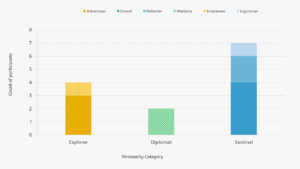
If you would like to share your results you can by sending it to me, Matt Adkins ([email protected]) to add to the graph and continue to celebrate the diversity of personalities within our network (for those of you concerned about privacy all results will be blind and we will not keep any record of your name or contact details associated with the results).
We’d also love it if you share your thoughts on the results (what surprised you, challenged you, delighted you etc.) and how it might change your approach in the future. We’d also love to hear about any other self-awareness activities you’ve participated in (eg. Leadership/Management courses) that have shaped your thinking and sense of who you are as a person and a change agent.
Next resource:

