
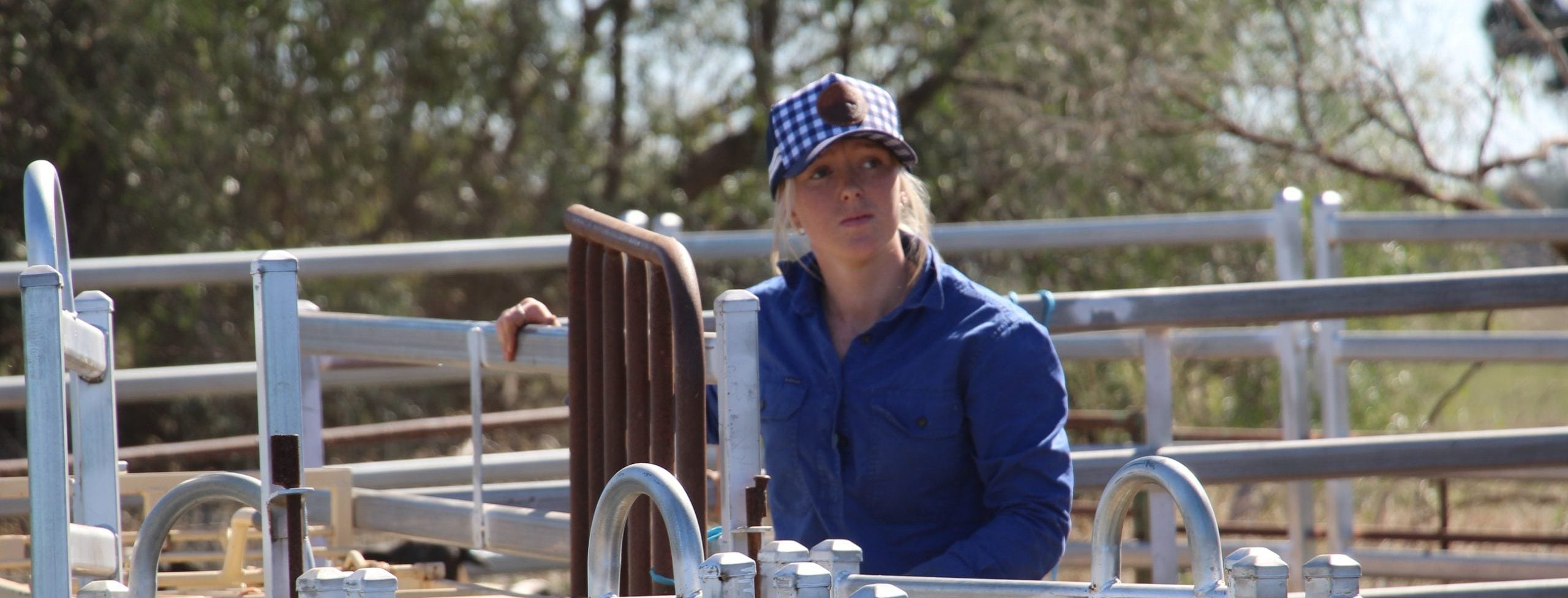
At 17, Shayla (Shay) Lister sidestepped her journey into livestock production, striking a share-farming agreement with local farmer Peter Gaudion. This partnership gave Shay access to land and mentoring, while Peter reduced his physical workload and actively supported his goal of bringing more young people, particularly women, into agriculture. Together they created a practical model that shares the upside and risk of seasonal variability.
Shay grew up on a small property where horses played a central role in her early life. Weekend competition riding helped build her confidence and passion for working with animals, laying the foundations for a future in livestock production. Thanks to family ties to dairy farming, agriculture felt familiar, but turning interest into a career still required a foothold. Halfway through year 11, Shay began a Certificate III in Agriculture but soon realised that a classroom setting did not support her learning style. Like many others, she thrives in hands-on environments, building practical skills and knowledge out on the farm.
Farm work and share farming
Peter Gaudion, an experienced farmer with multiple properties and a long-standing interest in agriculture, had been looking for young people to work with, and was “on a mission to get young people into agriculture.” After hearing about Shay through the La Trobe University stand at the Bendigo Sheep and Wool show, Peter offered her work across a mix of livestock operations, from drenching, vaccination, fencing and delivering lambs to market. The arrangement began as practical on-farm work, typically when labour was needed, but it quickly became clear that Shay had the potential to progress into a pathway towards ownership and greater involvement in decision-making.
After working with Peter for some time, Shay was offered another job working with a livestock contractor, mulesing and marking lambs, and now also works for Hamish Strawhorns large team at Strawhorn Shearing. Ultimately, Shay picked up new jobs through word-of-mouth and her eagerness to work and gain new experiences.
From Shay’s perspective, the share farming model provides a realistic bridge to early ownership. “I wasn’t really looking to own stock that quickly… Without Peter’s help, that would never be possible, not at my age.” said Shay.
eter encouraged a business discipline alongside the practical work, “you’ve got to have a plan,” he reminded her, and just as importantly, a commitment to review it; “you’ve got to review that plan and change it when things don’t work.”
The practical challenge, Shay notes, is coordinating multiple employers and seasonal peaks, “you’ve got to balance who you’re working for… it’s forward planning… If there were people my age that wanted to get into agriculture, I’d tell them… get your name out there, go to places, talk to people…,” said Shay.
Peter and Shay in the sheep yards of his property.
The structure of the share farming agreement
The arrangement between Peter and Shay is structured around clear who provides what commitments. Where Shay works with cattle owned by Peter, she receives 25% of the earnings, using her own gear and operating as a share farmer (not an employee). Where Peter provides the paddock, fences, feed and water and Shay supplies her own livestock, profits are split 50/50.
This structure creates two important outcomes:
- It reduces the upfront capital barrier for Shay while she builds experience and cash flow and;
- It rewards her directly for good management decisions.
Shay took up jobs to “fill in extra days and make extra money so that [she] could eventually own her own stock”. As Peter’s youngest share farmer, she now owns a small mob of cattle (Friesian Angus Cross) on one of Peter’s properties.
As share farmers operate independent businesses, they carry their own administrative responsibilities (including operating with an ABN and managing their own insurance and compliance). For Shay, the agreement gave her an “independent step” into farming, not just another roster. Peter also focused on broadening her exposure beyond one system, including opportunities to see how other farmers operate across both livestock and cropping enterprises. “It’s all about getting out and getting exposed”, Shay aims to cross breed her mob of Friesian Angus cows with a Shorthorn bull to produce Blue Roan breeders of the future.
In practical terms, the share farming arrangement has acted as a launchpad. It lowered the barrier to entry, created an opportunity to own and produce livestock, and provided the valuable guidance and support Shay required while moving from helping on farm to operating a livestock business. “Without Peters’ help, this would never be possible, not at my age.” said Shay.
Shay highlights growing opportunities for women and young people in agriculture. She explained that while shearing sheds have traditionally been male-dominated, this is changing, especially in wool-handling roles. “If young people would get onto a contractor and say I want to get into this sort of stuff, they’re willing to teach you in the sheds,” she said.
Acknowledgements
We would like to thank Shayla Lister and Peter Gaudion for their contributions towards this article.
This project is jointly funded through the Australian Government’s Future Drought Fund and the Victorian Government’s Sustainability Fund. More information about the Program can be found on the Agriculture Victoria webpage Farm Business Resilience Program.
Further information
To read more about Peter Gaudion’s story, visit
Agriculture Victoria works to support young farmers through the Young Farmers | Agriculture Victoria website.
To stay connected, visit Get in touch with your peers | Support and resources | Agriculture Victoria.
For further information on the Young Farmers Network, email [email protected].
