
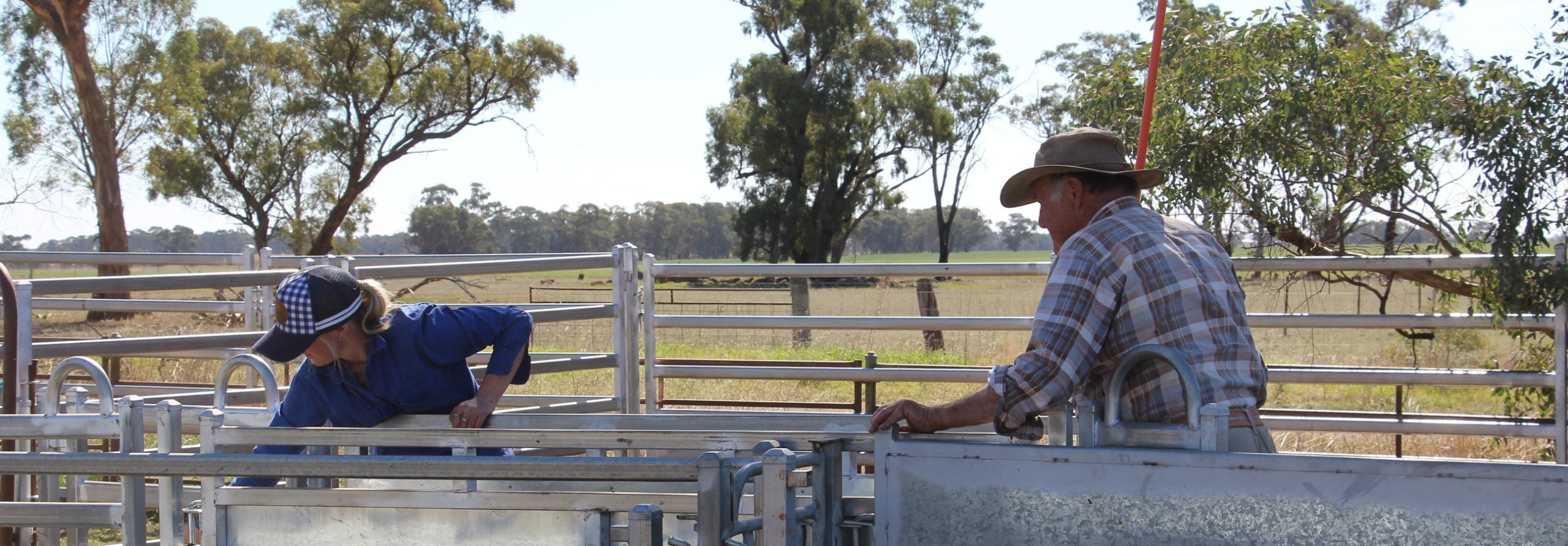
The Gaudions and the opportunities of share farming
Peter and Vicki Gaudion own 4,000 acres (1620 ha) of land, spanning across the North Central region of Victoria. They have a mix of livestock and cropping farms spread over 50 kilometres which are exposed to a range of seasonal conditions.
Peter is an accountant by trade and has also worked as a site manager in dairies at Bendigo and Melbourne for 15 years. Vicki is a nurse by trade becoming active in her family business after starting their family. They have always lived in rural Victoria, around 6 kilometres from the nearest traffic light, with their 3 daughters who are now spread across the state in Melbourne, Yarrawonga and Warrnambool. Peter believes none of his daughters will return to the farm to take over the business, as they have pursued various careers elsewhere, which has led him to take a different approach to future planning for the farm.
Peter and Vicki Gaudion herding sheep on their property in Marong.
Fifteen years ago, Peter purchased a property in Inglewood from a cropping farmer, with a share farming agreement in place. Share farming agreements take on many forms. For the Gaudions, it is an arrangement between a landowner and farmer who jointly manage a property, sharing both the costs and the income, so that risk and reward are divided to their agreed contribution. The Gaudions reserve the right to their properties to graze stubble after harvest, until the share farmer requires the paddocks for sowing. With the share farm arrangements Peter is not responsible for work cover, income tax or superannuation; the responsibility falls onto the sharefarmers as business owners, supporting them to build strong risk management skills and grow sustainable businesses.
Peter Gaudion on his property in Marong.
Now approaching 77-years-old, Peter is hoping to reduce his physical workload whilst also providing the younger generations with the opportunity to join the agriculture industry. Peter would ‘like to think in 3 years’ time, when [he] is 80, [he] won’t have any livestock,’ leaving the share farmers to own and manage livestock while he maintains and manages the structure of the farms.
The Gaudions share farm with 5 separate farmers, 2 cropping and 3 livestock, “each ones’ got a different story and they’re all younger than me,” said Peter.
Farm Business Resilience 2-day intensive workshop
Peter and Vicki engaged in a 2-day intensive Farm Business Resilience workshop in October 2025, with a face-to-face follow up session in February 2026. These sessions were delivered by Agriculture Victoria and were facilitated by Gavin Beever (Cumbre Consultants). These sessions covered succession planning, financials, farm resources, human relationships, business goals, climate risk and natural resource management, AgTech updates and tools and skills to help develop farm plans.
Vicki spoke on the value of “hearing [farmers] stories and seeing more of their personalities’ which helped to ‘build better relationships between communities.”
Farmers spoke freely about succession, partnerships and trusts, having honest conversations about future plans and how they can be actioned. This topic was particularly relevant to the Gaudions as their 3 daughters are unlikely to return to the farm business, and planning for the future is a key priority. These workshops prompted the Gaudions to further evaluate the somewhat novel approach they brought into their farming business 15 years ago. By implementing multiple arrangements with young croppers and livestock managers, share farming now forms a core part of their business resilience and generational renewal of the agriculture industry. These workshops helped to consolidate this approach and learn from other farmers’ experiences and aspirations. These workshops also made the Gaudions consider carbon accounting and to be open about actioning future projects around caring for the land.
The future of agriculture
The Gaudions are strong advocates for share farming and are encouraging the next generation to get involved in agriculture.
Their youngest sharefarmer, Shayla Lister, is involved in “doing all sorts of farm duties… everything from drenching, vaccinating, marking and taking lambs to market, fencing, and general farm duties.”
Peter believes that a purely wage-based role or lease can limit a young person’s ability to build a business, stating that share farming is ”the most logical way to do it”; but requires farmers to be “sharing the good years and the bad years” for the next generation so they are well versed in managing seasonal challenges and climatic events.
The Gaudions believe share farming is “getting young people, particularly girls and women the opportunity to be exposed to agriculture in an environment where they feel comfortable and supported”; and providing an “independent step”, which provides young farmers with opportunities into agriculture.
Acknowledgements
We would like to thank Peter and Vicki Gaudion for their contributions to this article.
This Farm Business Resilience Program is jointly funded through the Australian Government’s Future Drought Fund and the Victorian Government’s Sustainability Fund. More information about the Program can be found on the Agriculture Victoria webpage Farm Business Resilience Program.
Further information
To read more about Shayla Lister’s story, visit Young Farmers in Agriculture: Shayla Lister | Young Farmers Network.
For further information on the Farm Business Resilience Program, visit FBR | Farm Management | Agriculture Victoria.
