The Honey Bee Biosecurity Code of Practice has been updated

2026-06-04T10:50:07+10:00Biosecurity, Code of Practice, Managing your hives, Pests and diseases, Registration, Training & resources, Varroa|

The Australian Honey Bee Industry Biosecurity Code of Practice (the Code) was revised in late 2025 to reflect the establishment of Varroa destructor in parts of Australia. This summary outlines what beekeepers must do to be compliant. Where the Code has been legislated in your state or territory, Part B is compulsory for all beekeepers. Part C adds extra compulsory requirements for those managing 20 or more hives (reduced from 50 or more in the previous version of the Code). Compliance is by self-certification, supported by record checks by apiary officers. The Code does not replace state and territory beekeeping laws. If there is any inconsistency, the legislation takes precedence. What you must do as a beekeeper Part B – [...]
Varroa mite resources for Australian beekeepers – Essential information and support

2025-04-14T09:45:02+10:00Agrichemicals, Biosecurity, Breeding, Code of Practice, Managing your hives, Pests and diseases, Training & resources, Varroa|

Varroa mite is a major challenge for Australian beekeepers, but there are plenty of resources to help manage the pest and protect honey bee populations. The AgriFutures Australia Varroa Destructor Research Strategy (2024-2027) outlines the plan for future research, while the National Honey Bee Breeding Strategy offers guidance on strengthening bee populations. The National Varroa Mite Management Program offers a comprehensive framework for managing the mite, including pest control strategies and biosecurity guidelines. The Australian Honey Bee Industry Council (AHBIC) has made available a Varroa Chemical Treatment Table that lists approved treatments, as well as critical information on Withholding Periods to ensure safe use of chemicals. For practical advice, AHBIC podcasts and interviews offer insights from industry experts, while the [...]

Introduction to Integrated Pest Management for Beekeepers

2023-11-02T16:13:10+11:00Biosecurity, Managing your hives, Pests and diseases, Policy and compliance|

It can be overwhelming to decide how to manage pests and diseases in your honey bee colonies, especially when there is already a long list of things to accomplish in the apiary. However, pests and diseases can do irreversible damage and spread between colonies if ignored–that’s where integrated pest management (IPM) can help. IPM provides the framework for a balanced and effective control plan before an infestation gets out of hand. IPM works on the principle that the presence of a pest or disease in a hive is acceptable as long as it is below the level at which a beekeeper’s operation begins to suffer. Depending on the level of infestation, different treatment types are justified. IPM always begins with [...]

Who is Professional Beekeepers for?

2023-11-02T12:16:45+11:00Agrichemicals, Beekeeping on public land, Biosecurity, Breeding, Code of Practice, Disaster relief, Genetics, Honey, Managing your hives, Nutrition, Pests and diseases, Plan Bee, Policy and compliance, Pollination, Registration, Training & resources|

The Professional Beekeepers Community of Practice has been established to meet the needs of rural and regional Australians for the extension of beekeeping knowledge and to promote collaboration on important issues to commercial beekeeping. In short, we provide expert knowledge for a resilient beekeeping community.  Anyone can be a professional beekeeper. You can be a commercial beekeeper or a recreational beekeeper. To be a professional beekeeper you should: Register your hives Follow the Bee Biosecurity Code of Practice Be trained in the detection of pests and diseases Our articles are written and reviewed by experts in beekeeping and/or research, including beekeepers, researchers, bee biosecurity officers and trainers. We cover a wide range of topics and provide research updates, best practice, [...]

How does Varroa spread between hives, and what can we do about it?

2025-02-24T15:04:23+11:00Biosecurity, Code of Practice, Managing your hives, Pests and diseases, Varroa|

While we are hoping for a successful eradication of Varroa in New South Wales, beekeepers should prepare for the possibility of living with the pest. By following some simple biosecurity procedures, beekeepers can prevent or delay Varroa from infesting their apiaries. How does Varroa spread? To understand what biosecurity measures are required to limit the spread of Varroa, we must first understand how Varroa spreads in the first place (Figure 1). Figure 1. How Varroa spreads within and between apiaries. The yellow hive is the first hive to be infested with Varroa. Varroa spreads to other hives in the apiary via bee drift or the beekeeper moving infested frames of bees to other colonies (orange arrows). The yellow colony [...]

What to do if a slime-out occurs

2023-04-21T13:43:56+10:00Biosecurity, Managing your hives, Pests and diseases|

Small hive beetle (SHB) is a pest that causes issues in many parts of Australia. In some cases, SHB can contaminate honey with Kodamaea yeast, causing the honey to ferment and ‘slime-out’, making the resulting honey not fit for consumption. As a slimed-out beehive is often a horrible mess and potentially harmful to our health; many beekeepers do not examine the frames. In their eyes “hive beetles killed my beehive” and the story basically stops there. Unfortunately, this mishandling of the equipment often fuels the later re-emergence of American foulbrood (AFB) infections. Any colony that has experienced AFB is a biosecurity risk and so if you cannot 100% identify what killed your hive then treat it like it has AFB. [...]

Does Australia have Varroa mite predators?

2022-11-04T15:46:47+11:00Biosecurity, Managing your hives, Pests and diseases|

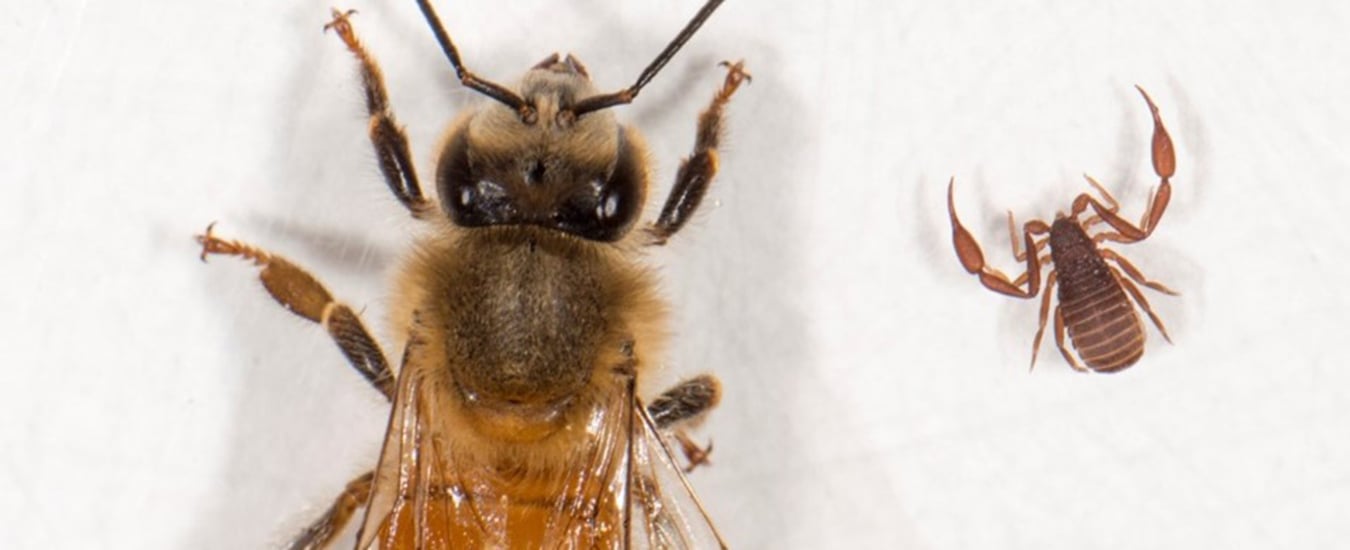
Do our bees have useful associates that attack Varroa mites? – you can help. Above: A honey bee next to an adult Chelifer cancroides (pseudoscorpion). Image courtesy Robert Lamberts, PFR With the threat of Varroa mite looming large, it might be helpful to see what defences our bees may have in or around their hives. Overseas where insecticide resistance in Varroa mite is a concern, researchers have been testing Varroa mite predators that are compatible with bees. One candidate is the pseudoscorpion Chelifer cancroides. This critter has been studied by New Zealand bio-protection researcher with beekeeping experience, Ron van Toor (Plant & Food Research, NZ (PFR)). The pseudoscorpion isn’t an actual scorpion (it has no sting) but it [...]

How bees fight Varroa

2022-07-15T17:54:29+10:00Biosecurity, Pests and diseases, Plan Bee|

Varroa destructor is an ectoparasitic mite that feeds on adult and developing bees. This weakens the bees, reduces body weight, decreases flight performance, causes learning difficulties, and reduces life span. The mite also transmits viruses, which can have a wide variety of effects. At each point in the Varroa life-cycle (Figure 1) the bees fight back to prevent Varroa populations from exploding.   Figure 1: Top: the Varroa lifecycle. Bottom: the strategies employed by honey bees to prevent mite population growth.   Phoretic phase - on adult bees Varroa mite on a worker bee inside the hive. (Alexander Wild, The University of Texas at Austin) The life cycle starts when the Varroa mite emerges from a [...]

Help eradicate Varroa mite

2022-07-14T08:40:16+10:00Biosecurity, Pests and diseases, Policy and compliance|

NSW Department of Primary Industries’ early warning system has detected Varroa mites, which was confirmed as Varroa destructor species, in biosecurity surveillance hives at the Port of Newcastle on 22 June 2022. NSW DPI is working to protect the NSW and broader Australian beekeeping industry by ensuring we eradicate this parasite. Where it is established, Varroa destructor is globally the most damaging pest of honey bees.  The eradication plan is supported by a NSW statewide emergency order to control the movement of honey bee hives. This vital order will help NSW DPI undertake the Varroa eradication plan with the greatest chance of success. The eradication plan is also supported by four Varroa mite emergency zones covering an area within a 50 km [...]

Australian beekeepers need to regularly check for exotic mites

2021-11-10T09:54:56+11:00Biosecurity, Code of Practice, Managing your hives, Pests and diseases, Policy and compliance|

Australian honey industry at risk from exotic mites  The majority of Australian beekeepers are completely unskilled and unprepared should mites arrive to our shores and start impacting our bees.  All around the world, the best performing and most profitable beekeepers are always those that undertake a lot of mite surveillance on their hives. They know this management tool is important to the health of both their operation and bottom line. Australia lags way behind any other nation in this regard. If an exotic mite becomes established in Australia, then all beekeepers will need to undertake a lot more work (and spend more money) to manage their colonies and keep them viable.  The mites are parasitic and feed on developing brood [...]

Go to Top